
Custom Motor-Part Rigid Gift Box | EVA-Lined Industrial-Component Packaging
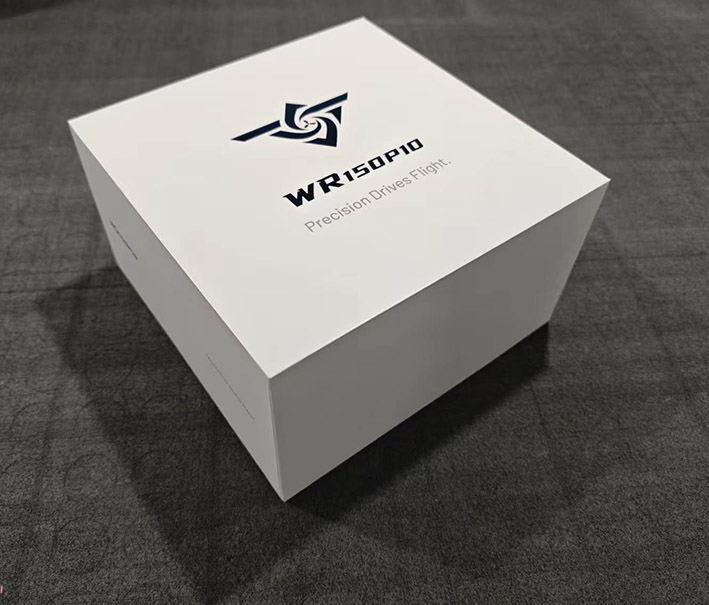
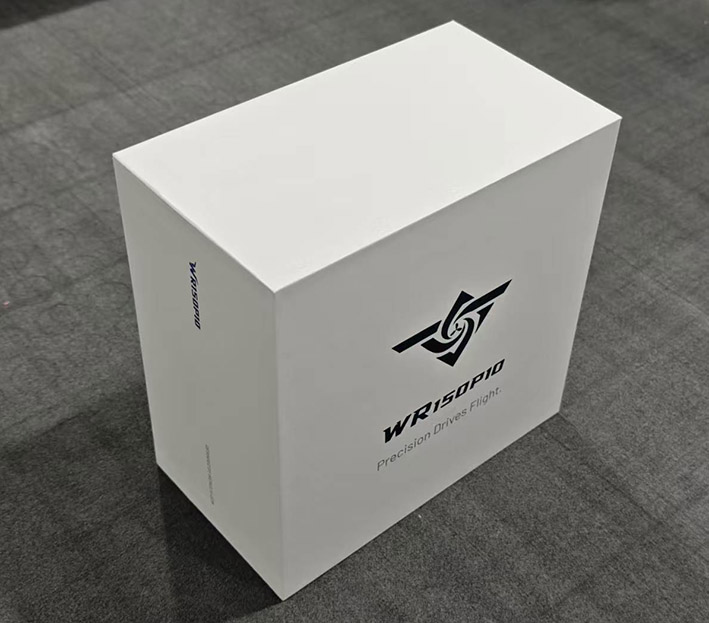
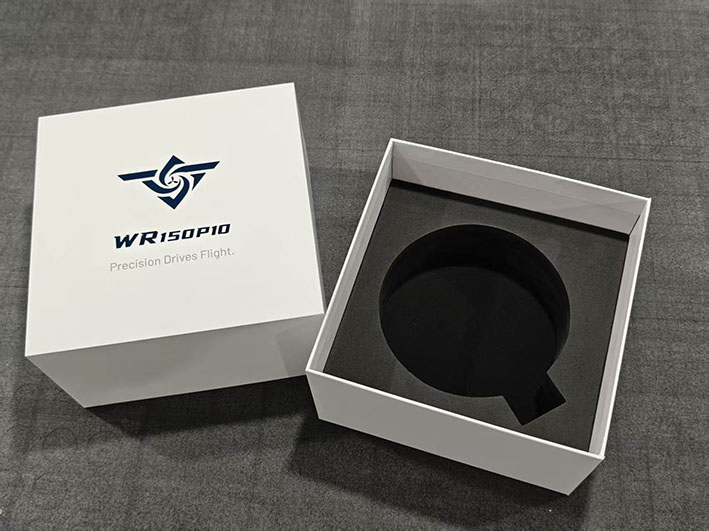
Custom premium packaging for motor parts and industrial components. A rigid lid-and-base gift box paired with a project-specific EVA insert, with internal cavities designed around your part's actual dimensions to deliver product positioning, cushioning and a clean, presentable display. Small-batch customization and rapid sampling are both available.
📸 📸 Product Images
📖 📖 More Details
Custom Rigid Lid-and-Base Gift Box for Motor Parts | EVA Insert Protects Industrial Components
The goal is not to find a box for the part — it is to make the packaging truly fit the product.
Some products, even though they are industrial components, should not be hidden inside an ordinary shipping carton.
This time the client needed to package a motor part — metal surface, regular geometry, with non-trivial weight. The client wanted reliable protection during delivery, sample testing and customer acceptance, while still conveying the quality of the product itself and the brand image behind it.
Instead of starting from a box style, we worked in reverse: we confirmed the motor part first — length, width, height, outer profile, raised features, impact-prone areas, product weight, handling method — and only then decided the box style, EVA insert, materials and finishing.
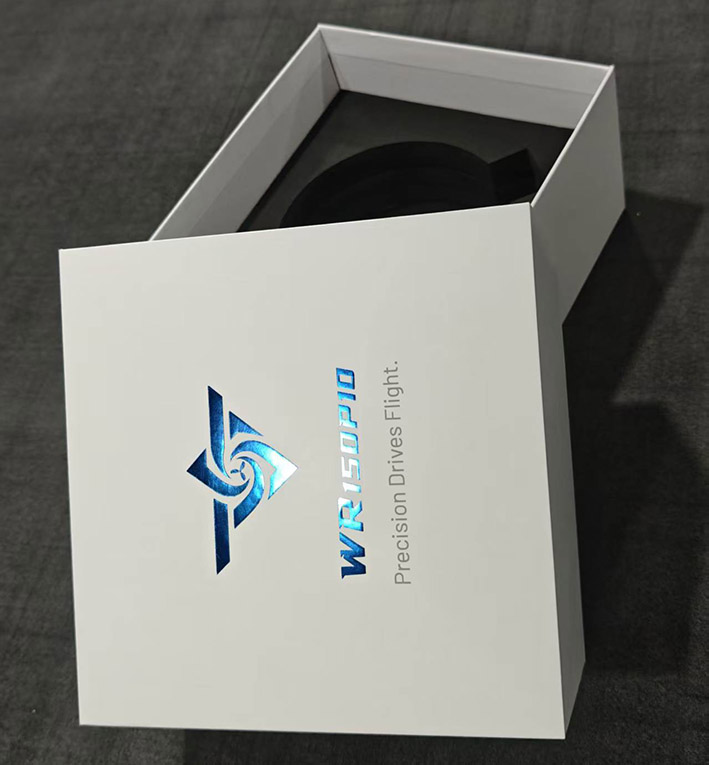
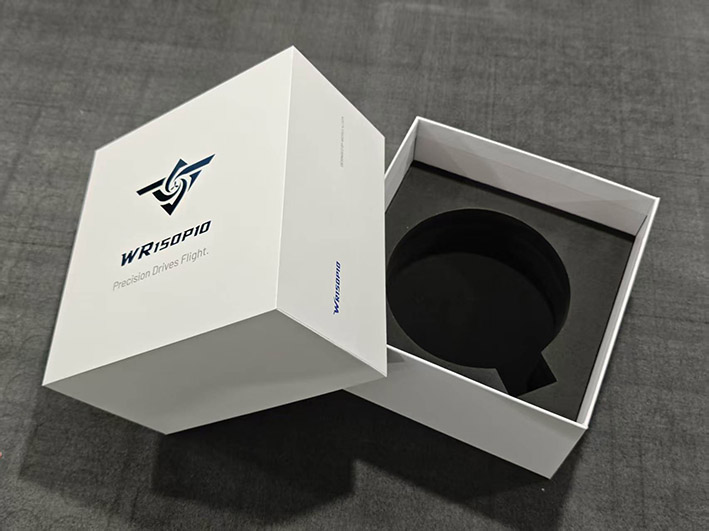
The final solution is a combination of a rigid lid-and-base premium gift box and a project-specific EVA insert: the rigid outer shell establishes the premium packaging look, while the inner EVA cavities are tailored to the part's actual size and geometry to keep the product stable inside the box and reduce shifting and impact during transport and handling.
This type of packaging is not simply about putting a 'gift box' and 'industrial packaging' together; it requires balancing product protection, internal positioning, opening experience, surface feel and real production feasibility at the same time.
01 | Why do industrial motor parts also need premium packaging?
The traditional packaging logic for many industrial components is fairly simple:
Product → plastic bag / foam → corrugated carton
This approach handles basic transit, but falls short when the product needs to:
- Be delivered as a sample for client testing
- Be shown at a new-product launch or trade fair
- Be shipped together with high-end equipment
- Be presented as a corporate gift or a business delivery
- Reflect the manufacturer's capability and brand image
An ordinary shipping carton struggles to meet all of these requirements at once.
For a motor part in particular — even though it is technically an industrial component — what the customer sees when they receive it is not just a 'part', but a piece of the manufacturer's capability, the product's quality, and the brand behind it.
For these products, the packaging can therefore be upgraded from purely 'transport packaging' to: protect the product, and showcase the product.
02 | The lid-and-base structure gives industrial products the ceremony of a premium gift box
This project uses a lid-and-base (天地盖) box style.
The lid-and-base box consists of a top cover and a bottom tray, with a clean structure and a stiff overall feel. Compared with ordinary folding cartons, a rigid lid-and-base box more easily forms a stable shell and also makes it easier to design different internal spaces and EVA trays around the product's size.
This packaging answers three questions at once:
First, how the product is protected. A custom EVA insert creates a self-contained positioning space inside the box.
Second, how the product is fixed in place. Instead of simply dropping it in, the cavities are designed around the actual outline of the part so the product and the insert work together properly.
Third, how an industrial product conveys quality. Through the rigid lid-and-base structure, the outer materials, printing and surface finishing, a more industrial-looking package is turned into a more complete brand package.
03 | The EVA insert is not 'filler' — it is part of the package structure
The EVA insert is a very important element in this kind of packaging.
Many people think of EVA as just 'foam padding'. In reality, for industrial products that carry real value, have unusual geometry, or need stable positioning, the EVA insert actually does:
- Positioning — holds a fixed location inside the box
- Cushioning — absorbs vibration during transport
- Separation — partitions multiple parts or accessories
- Presentation — black or dark EVA combined with metal parts creates a premium visual
Compared with simple cavity filling, a custom insert gives much tighter control over how the product moves inside the package.
The design logic works in reverse:
- Do not start from a standard EVA and force the product to fit the package
- Start from the product, then design the EVA cut-outs and positioning around the product's geometry
- Based on the motor part's length, width, height, outer profile, raised features, impact-prone areas, product weight and handling method, define the EVA cut-outs and positioning
Only then does the packaging truly serve the product.
04 | Why is ordinary foam not enough?
If the goal is simply to fill empty space, ordinary foam is perfectly fine.
But when the client asks for protection plus a premium feel plus positioning plus an unboxing display, EVA is usually the better fit for that role.
A custom EVA insert can form a fairly precise outline and cavity for the product, so the product does not sit loosely inside. Combined with a rigid premium box, black or coloured EVA also creates a more unified, finished interior look.
For samples, parts or product sets that need to be repeatedly removed and replaced, this kind of 'fixed-location' design also makes it easy for the user to confirm at a glance that everything is complete.
05 | The real difficulty: coordinating the lid-and-base box and the EVA across six coupled dimensions
A seemingly simple lid-and-base gift box actually requires a great deal of detail in production.
Once an EVA insert is added, you can no longer only look at the product's dimensions. You need to consider a six-way coupled relationship:
Product size → EVA thickness → cavity depth → inner box height → lid height → compression fit when closedIf the EVA is too tall: the lid may compress the product when closed.
If the cavity is too deep: the product is hard to take out.
If the cavity is too loose: the product shifts during transport.
If the cavity is too tight: it affects handling and may add edge load on the product.
EVA insert design is therefore a packaging-structure matching problem, not simply 'cut a hole'.
06 | From 'it fits in' to 'it comes out comfortably' — both matter
Industrial packaging often overlooks one question: how does the user actually pick the product up?
Package design cannot stop at 'the product goes in'. It must also consider whether the customer can comfortably remove the product once the box is opened. So the EVA insert must leave room for:
- Finger space
- Pick-up clearance
- Edge gaps around the product
- Opening clearance
This matters even more for heavy motor parts.
A good insert should achieve: the product sits stably inside, and the customer takes it out easily.
07 | Premium packaging does not mean it is only for 'gifts'
Although this type of packaging is called a premium gift box, its use cases go well beyond traditional gifts. For industrial companies:
- Industrial product samples — for new-product sampling, client testing, and engineer-sample delivery
- High-value components — precision components that need individual protection and branded packaging
- Motors and matching parts — premium packaging for motor parts, mechanical components and equipment accessories
- Business delivery — when the product must be handed to an important customer, the packaging itself becomes part of the corporate image
- Trade fairs and new-product launches — for trade-show samples, technical exchanges and new-product displays
Whether to use premium packaging depends on the product's use case, not on whether the product is industrial.
08 | Small-batch industrial premium packaging is also possible
Industrial clients often run into a real-world problem: the product may only be a new product, a sample, a small-batch order, a project-specific build, or a multi-model product — so a single run may not need thousands or tens of thousands of packages.
If you produce using traditional high-volume packaging logic, you easily end up with:
Excess packaging quantity → inventory pile-up → hard-to-manage multi-model packaging
For products like these, small-batch, customized, multi-SKU packaging is a better fit. Clients with many models and limited quantity per model should plan packaging around real demand rather than over-producing to lower unit cost.
09 | Start from the actual product, not from a standard box style
Few industrial components are exactly identical. Even within motor parts, different models often differ significantly.
This kind of packaging therefore cannot simply be produced in one fixed size. Package structure needs to be planned based on what the client provides:
- The physical product
- Product dimensions
- CAD drawings
- Product photos
- Packaging size requirements
When using an EVA insert, in particular, supplying the physical product or accurate dimensional data tends to make it much easier to determine the internal cavities and handling method.
10 | What was finalized for this packaging (reference specification)
| Item | Specification |
|---|---|
| Box style | Rigid lid-and-base box |
| Face paper | 157g C2S art paper |
| Grey board | 1200g duplex grey board (reference) |
| Printing | CMYK printing / optional spot UV / hot foil stamping |
| Surface finish | Matte lamination |
| Insert | EVA molded insert (black, density adjustable) |
| Closure | Lid-and-base (no magnet) |
| First batch | 500 pcs MOQ (reference) |
| Sampling lead time | 3-5 days |
| Production lead time | 7-12 days |
The exact grey-board thickness, EVA density, finishing combination and per-box price need to be re-quoted based on the part's actual dimensions, weight and order quantity — the set above is a common configuration for this type of motor-part gift box, not the final spec.
11 | If you are also customizing industrial-product packaging
If your product is a motor part, precision mechanical component, metal part, hardware fitting, equipment accessory, industrial sample or instrument accessory, and you want packaging that delivers protection plus positioning plus premium feel plus brand display, consider the rigid lid-and-base premium box plus custom EVA insert combination.
Three things are enough to get started:
- Physical product or CAD drawings
- Part dimensions and weight
- First-batch quantity and use case (sample / business delivery / trade show)
12 | You may also be interested in these industrial-product packaging cases
- Precision mechanical-component premium lid-and-base box (EVA molded positioning)
- Heavy-duty metal-part packaging (corrugated + EVA insert reinforcement)
- Industrial-sample small-batch gift box (multi-SKU customization)
🎨 🎨 Optional Techniques
- CMYK printing
- Spot UV
- Hot foil stamping
- Matte lamination
- Embossing
📐 📐 Common Materials
- 157g C2S art paper
- 1200g duplex grey board
- EVA molded insert
🏭 🏭 Applicable Industries
FAQ
Why is a rigid lid-and-base premium gift box a good fit for motor parts?
When the product needs more than just transit protection — such as client delivery, sample display or brand representation — a rigid lid-and-base premium box balances outer appearance and inner structure. Combined with a custom EVA insert, it adds product positioning and protection. Note: this kind of premium gift box suits short- to medium-distance, low-quantity sample or business-delivery scenarios; long-distance courier transit still needs an outer transport package.
Can the EVA insert be customized to the motor part's geometry?
Yes. The EVA insert is normally designed around the product's length, width, height and exact geometry. For complex parts, we recommend providing a physical sample, CAD drawings or accurate dimensions so the inner structure can be finalized. EVA molding is a 1:1 mold cut to the part, and each project is shaped separately.
Will the EVA insert hold the product too tightly?
No — the cavity is not simply 'clamped dead' against the product's geometry. The design must consider product dimensional tolerance, EVA material elasticity, cavity depth and the pick-up method, balancing secure holding against easy removal. For your specific project, the cavity tightness can only be confirmed once we see the part drawings.
The motor part is fairly heavy — can EVA still be used?
Yes, but you cannot decide based on the label 'motor part' alone. EVA density and thickness must be matched to the product's actual weight, load-bearing points, transport method and package dimensions. For heavier products (e.g. above 5kg), structural design is needed around the load points and stress areas; EVA cushioning alone is not enough — bottom reinforcement is usually required.
Can the EVA insert hold multiple parts at the same time?
Yes. Multiple independent cavities can be designed based on product count, and parts of different sizes can be laid out into separate zones so each product stays independent inside the box. A common layout: one position for the main part, separate slots for accessories or manuals, so customer acceptance is clear at a glance.
We have multiple part models — can they share one gift box?
It depends on the dimensional difference between models. If the sizes are close, the insert can be designed for compatibility; if the size difference is large, separate EVA inserts — and even separate box dimensions — are usually the better call. Forcing a shared box forces the insert to compromise, and both sides end up worse off.
Can we customize only the EVA insert, without the gift box?
Yes. If you already have an existing box, we can redesign the EVA layout around its inner dimensions. One caveat: if the existing box is an ordinary corrugated carton, the premium-display effect an EVA insert can deliver is limited — the premium feel comes from a rigid box shell and a refined insert working together.
Is a rigid lid-and-base gift box suitable for industrial-product transit?
You need to distinguish 'display packaging' from 'transport packaging'. The rigid lid-and-base premium box suits product display, sample delivery and small-quantity premium scenarios. If the product will go through long-distance courier or complex logistics, outer transport protection — such as an extra corrugated carton or wooden cradle — must be added; the premium box alone cannot carry the entire transit load.
Do industrial parts always need a premium gift box?
Not necessarily. If the product is in standard bulk transit and the main goal is lowering per-unit packaging cost, corrugated cartons or other transport packaging may be more appropriate. Premium gift boxes suit sample delivery, customer display, brand presentation or high-value product handover. The point is not 'gift boxes are always better' — it is whether the packaging matches the product's actual use case.
Can this packaging be customized in small batches?
Yes, but the cost structure changes. 500 pcs is the typical MOQ for this kind of gift box — below that, die-cutting fees, machine setup fees and dedicated plate-tuning costs get spread across fewer units, and the unit price rises noticeably. If you need 100-300 pcs, consider simplifying finishing (dropping local UV or hot foil), reusing existing box tooling, or raising the order to 500 and shipping in batches.
We don't have packaging artwork yet — can we go straight to production?
We can discuss it. Provide the physical product, CAD drawings or existing packaging and the supplier can determine the box style, insert and visual finishing based on the product and use case — LOGO layout, colour matching and surface finishing choices can all be handled by the supplier. The prerequisite is that the physical product or drawings must be supplied; without product data, packaging structure cannot be reverse-engineered.
The boss asks — won't a premium gift box make customers feel 'too formal, like a burden'?
This is a common misconception. A premium gift box does not communicate 'so expensive it feels like a burden' — it communicates 'we take this delivery seriously'. If the customer receives an ordinary corrugated carton, the first reaction is 'this is just a part'; if they receive a rigid lid-and-base premium box plus a custom EVA, the first reaction is 'this company has standards for its own product'. The two impressions have very different long-term implications for the relationship.
What is the sampling and delivery lead time?
Sampling: 3-5 days (irregular parts need an extra 1-2 days to build the EVA mold first); bulk production: 7-12 days. If you have a fixed delivery milestone (such as a client appreciation event, dealer conference or trade show), start 25-30 days in advance and leave at least a 2-week buffer. Rush orders can be done (5-7 days delivery), but finishing choices will be limited — hot foil stamping and UV, which need drying time, will compress the timeline.
Is a thicker EVA insert always better?
No. EVA thickness must consider product weight, cavity depth, internal box space, cushioning requirement and opening method together. Too thick can enlarge the box or interfere with the lid closing; too thin may not meet positioning or protection needs. General rule: lightweight precision parts 10-15mm, standard parts 15-25mm, heavy or irregular parts 25-40mm — confirm against the physical product.
What other products is this packaging suitable for?
Beyond motor parts, it also suits mechanical components, hardware fittings, industrial samples, instrument accessories, electronic components, equipment accessories, precision parts and other products that need a custom protective insert. The test is not the product category but whether the product needs all four attributes at once: protection, positioning, display and brand image.
📦 📦 Related Products
Need a Custom Packaging Solution?
Submit your needs for a professional quote and production advice